In today’s fast-paced and ever-changing business environment, organizations face immense pressures from rapid technological advances and operational complexities to global competition and evolving customer expectations. In such a context, knowledge management has emerged as a critical strategic enabler. Knowledge is no longer just a by-product of operations; it is a vital resource that drives decision-making, enhances productivity, fuels innovation, and improves service quality across all levels of an organization. Those organizations that can effectively identify, organize, and share knowledge position themselves for sustainable success.
As a senior knowledge management consultant engaged with the NATIONAL IRAN GAS COMPANY (NIGC), I was tasked with evaluating their knowledge management practices and identifying opportunities to capture and leverage the vast experience of employees. Through careful observations, interviews, and workflow analyses across multiple departments and provinces, it became clear that while explicit knowledge—documented procedures, technical manuals, and databases—was reasonably well-managed, much of the organization’s tacit knowledge remained untapped. This tacit knowledge, which exists in the minds of experienced employees, includes practical know-how, contextual understanding of complex systems, and lessons learned from years of hands-on problem-solving. Losing this knowledge, especially as senior employees retire or transfer, would significantly impact operational efficiency, safety, and service quality.
Moreover, operations in the gas industry are inherently high-risk, with safety and reliability being paramount. Decisions must often be made under pressure, and even minor errors can have serious consequences. It was evident that the organization needed a solution that could accelerate knowledge transfer, enhance collaboration, and stimulate creative problem-solving. After a comprehensive assessment and benchmarking of global best practices, I concluded that the Knowledge Café would be a highly effective approach for NIGC. This method creates an informal, participatory environment that encourages open dialogue, the exchange of experiences, and the collaborative generation of solutions.
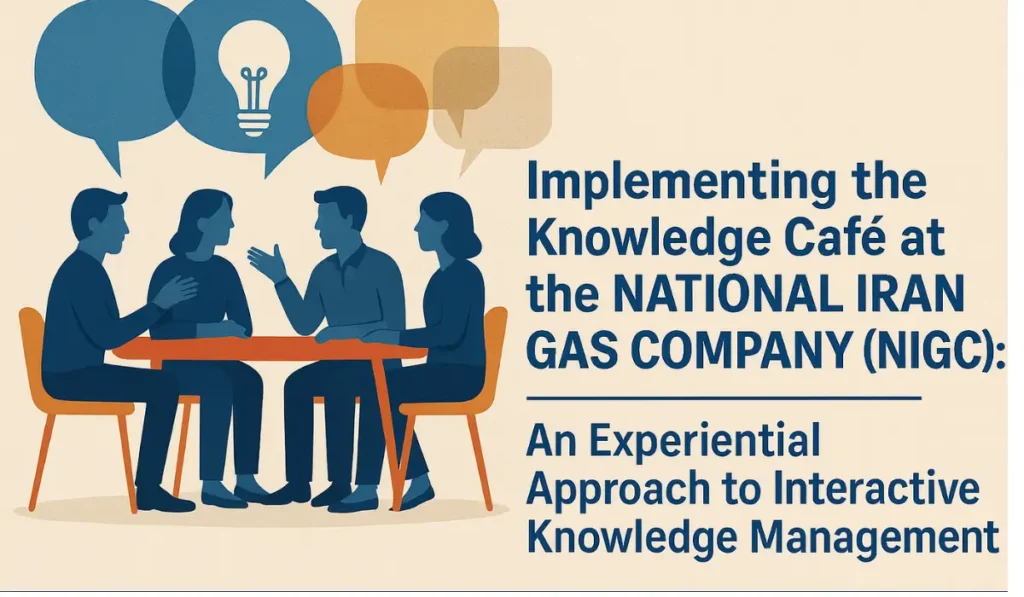
The Knowledge Café is designed to mimic the casual, welcoming atmosphere of a café, where participants can engage in discussions without the constraints of formal meetings. The essence of this technique lies in fostering open dialogue, tapping into tacit knowledge, and building a shared understanding among participants from diverse backgrounds. By creating a psychologically safe space, participants are encouraged to share their insights, challenge assumptions, and explore innovative ideas freely. In my role as a consultant, I facilitated these sessions with a focus on maximizing participation, ensuring balanced discussions, and translating ideas into actionable solutions.
At NIGC, the Knowledge Café was implemented with several clear objectives. First, it aimed to enhance innovation and creativity. Employees were invited to contribute ideas for optimizing operational processes, improving technical inspections, and delivering better service to customers. Through open discussions, they explored innovative solutions to recurring challenges, combining field experience with new perspectives from colleagues across the organization.
Second, the initiative focused on improving operational processes. By mapping workflows and identifying bottlenecks, participants collaboratively developed practical recommendations to accelerate technical inspections and streamline operational procedures. For example, during the sessions, employees shared insights on how certain inspection steps could be standardized or automated without compromising quality or safety, significantly reducing lead times and potential errors.
Third, the Knowledge Café strengthened cross-departmental and cross-provincial collaboration. Representatives from multiple provinces, including central and regional offices, came together to exchange experiences and learn from each other. This interaction not only promoted the dissemination of best practices but also cultivated a sense of unity and shared purpose across the organization.
Another key objective was the creation of a shared organizational knowledge base. Discussions were meticulously documented, and insights from each session were compiled into a comprehensive repository. This repository now serves as a reference for new employees and provides decision-makers with quick access to accumulated expertise, procedural tips, and lessons learned from past challenges.
Employee engagement and satisfaction were additional benefits. By providing a platform where every voice could be heard, participants felt valued and recognized. This sense of belonging and active participation enhanced motivation and fostered a culture of continuous learning and improvement. The sessions also demonstrated that employees are more likely to implement ideas they have helped generate, increasing the likelihood of successful change initiatives.
The Knowledge Café at NIGC was implemented in five structured stages:
- Defining Objectives and Topics: We identified operational challenges and formulated provocative questions to guide discussions, such as, “How can we make technical inspections faster and more accurate?” and “What tools or methods could simplify our workflow?” These questions catalyzed creative problem-solving.
- Selecting Participants: Representatives from multiple provinces and departments were carefully chosen to ensure diverse perspectives. This approach captured a wide range of experiences, from frontline operators to regional managers, making solutions both practical and comprehensive.
- Preparing the Environment: A calm, circular, informal meeting space encouraged interaction. Comfortable seating, minimal distractions, and tools for documenting ideas allowed participants to focus fully on dialogue and collaboration.
- Choosing a Facilitator: A skilled facilitator guided discussions, ensured all voices were heard, and kept sessions constructive without stifling creativity. The facilitator created trust, allowing participants to confidently share successes and challenges.
- Conducting the Event: Sessions began with an introduction to objectives and key questions. Participants engaged in open discussions, shared insights, proposed solutions, and debated feasibility. At the conclusion, the facilitator summarized ideas and documented seventeen actionable solutions for improving technical inspections, now actively implemented and monitored by NIGC’s operational units.
Throughout the process, several factors proved critical to the success of the Knowledge Café: fostering trust and psychological safety, encouraging active participation, practicing active listening, providing concise summaries of discussions, and following up on action items. By emphasizing these elements, we ensured that the sessions were not merely theoretical exercises but produced practical outcomes with measurable impact.
The results were compelling. Beyond achieving the immediate goal of improving technical inspections, the Knowledge Café facilitated cross-departmental knowledge sharing, increased employee engagement, and stimulated creative problem-solving. Employees expressed appreciation for the opportunity to contribute meaningfully to organizational improvements, and managers reported faster adoption of best practices. The initiative also highlighted the immense value of tacit knowledge and demonstrated that interactive, informal approaches can unlock insights that formal processes alone often overlook.
From my perspective as part of DANA Knowledge Management Consulting Group, the NIGC experience underscores the transformative potential of Knowledge Café. By integrating structured facilitation, diverse participation, and a safe environment for dialogue, organizations can convert tacit and explicit knowledge into strategic assets. Moreover, this approach can be scaled to other subsidiaries, departments, or similar organizations globally, offering a practical framework for enhancing operational efficiency, innovation, and sustainable development.
In conclusion, the implementation of the Knowledge Café at the National Iranian Gas Company (NIGC) and its provincial branch in Khorasan Razavi serves as a successful model of interactive knowledge management. It demonstrates that organizations can cultivate a culture of continuous learning, collaboration, and innovation by creating spaces where employees feel empowered to share expertise and co-create solutions. For organizations operating in complex, high-stakes environments, the Knowledge Café is not merely a knowledge-sharing tool—it is a strategic approach to building resilience, improving performance, and cultivating a workforce that is engaged, motivated, and ready to meet evolving challenges.
Author

I am a Knowledge Management consultant and instructor, currently serving as a Board Member and Senior Project Manager at DANA KM Consulting Group, a leading KM consulting firm in Iran.
Drawing on over 15 years of hands-on experience, I help organizations transform KM strategies into practical systems that drive collaboration, innovation, and continuous learning. Over the years, I have contributed as a consultant to more than 100 KM projects, implementing effective techniques and solutions that have enhanced organizational knowledge performance.
Internationally, I have completed professional development programs in management consulting and hold a Productivity Specialist certification from the Asian Productivity Organization (APO).
Since 2019, I have been the Editor-in-Chief of the “DANA Knowledge Management and Innovation Journal,” which has published over 40 issues, promoting thought leadership and best practices in the KM community. In addition, since 2023, I have served as the Executive Secretary of the Knowledge Management Excellence Award in Iran, a national initiative that assesses and recognizes outstanding KM practices across organizations.



Read: When Culture Leads: The Hidden Force Behind Knowledge Management
Read : Turning Ugly Ducklings into Knowledge Champions
Read: Knowledge Champions Cup: Driving Engagement and Learning through Gamified Knowledge Management