
Over a ten-year implementation period, the GIZ Dry Valley Rehabilitation and Productive Use (DVRPU) approach demonstrated how strategic and systematic knowledge management (KM) can transform localized soil and water conservation innovations into institutionalized practices, national policy, and long-term environmental resilience. The experience highlights the critical role of KM in bridging the gap between innovation and institutional adoption, ensuring that successful approaches are not confined to individual project sites but are documented, validated, adapted, replicated, and integrated into government systems. By embedding knowledge generation, partners’ platforms, documentation, and institutional knowledge-sharing mechanisms throughout implementation, the approach helped establish the foundations for sustaining and scaling land rehabilitation interventions beyond donor funding cycles.
Ethiopia’s arid and semi-arid lowlands face persistent challenges associated with soil degradation, recurrent drought, declining water availability, and unsustainable land-use practices. These challenges threaten ecosystem health and undermine the livelihoods of pastoral and agro-pastoral communities that depend on fragile natural resources. Addressing these interconnected challenges requires more than introducing technical solutions; it requires approaches that generate locally relevant knowledge, strengthen institutional capacity, facilitate learning, and support the adoption of innovations within existing government systems.
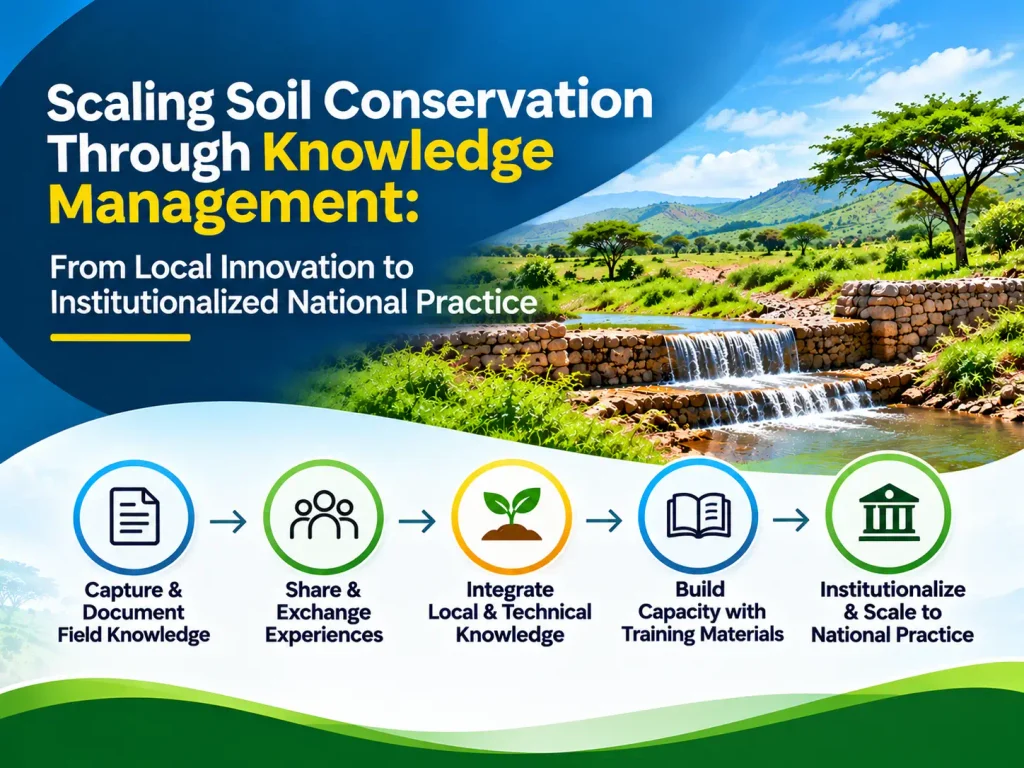
The DVRPU approach embedded knowledge management across the implementation cycle, positioning it as a core strategy for generating evidence, facilitating adaptation, and institutionalizing effective practices. Practical innovations, including water spreading weirs (WSWs), check dams, and complementary biological soil and water conservation measures, were systematically documented to capture implementation experiences, technical processes, contextual requirements, and lessons learned. This documentation transformed field-level experiences into structured and transferable knowledge that could inform future interventions, support technical replication, and guide decision-making by government institutions and development partners.
Beyond documentation, the project established multi-tiered knowledge-sharing and exchange mechanisms to facilitate the transfer of practical experience between communities, technical experts, and institutions. These included the DVRPU partners’ platform and cross-regional and international ProSoil exchange visits involving pastoralists and local government officials. These platforms provided opportunities to observe successful interventions, exchange experiences, compare implementation approaches, and adapt proven practices to different ecological and institutional contexts.
The integration of local knowledge with scientific and technical approaches further strengthened the contextual relevance and sustainability of the interventions. Community participation, including the involvement of community watershed users’ cooperative societies, helped connect technical rehabilitation measures with local resource management systems and community stewardship arrangements. This created opportunities for innovations to be understood, accepted, and maintained by the communities responsible for managing rehabilitated watersheds and rangelands.
Another critical contribution of KM was the development and institutionalization of structured databases to systematically capture and track rehabilitation interventions, implementation progress, and relevant field information. These knowledge systems improved the availability and accessibility of information for monitoring, learning, planning, and evidence-based decision-making. Rather than allowing implementation experiences and technical information to remain dispersed across project teams and locations, the databases and associated knowledge products provided a foundation for supporting continuity in government-led rehabilitation efforts.
Institutionalization and scale-up
The impact of the DVRPU knowledge management approach became particularly evident in the transition of project-generated innovations into government policies, institutional practices, and capacity-development systems. One of the most significant achievements was the integration of water spreading weir technology into the Ministry of Agriculture’s national soil conservation and rangeland management strategies. This represented an important shift from a project-supported intervention to an approach recognized within national development and natural resource management frameworks.
This transition illustrates how KM can influence institutional adoption. Through systematic documentation of field experiences, demonstration of practical results, knowledge exchange, and engagement with government stakeholders, the project helped build an evidence base that made innovative practices more accessible to decision-makers. Knowledge products provided the technical information required to understand the intervention, while learning platforms enabled stakeholders to observe its application and assess its relevance to their own contexts. Together, these mechanisms helped move innovation beyond individual demonstration sites and supported its consideration and integration within broader institutional frameworks.
The development of Teaching, Training and Learning Materials and technical manuals also played a significant role in institutionalizing the approach. By incorporating project-generated knowledge into structured learning resources and core training curricula, the project helped translate practical implementation experience into institutional capacity. These materials provided government technical personnel and other stakeholders with standardized guidance on rehabilitation approaches, implementation processes, and relevant technical considerations. More importantly, integrating these resources into institutional training systems created opportunities for knowledge to be transferred to new generations of professionals, reducing dependence on individual project experts and supporting continuity in technical capacity.
The institutionalization of knowledge was further reinforced through the establishment of accessible databases and knowledge-sharing platforms. These mechanisms supported the retention and use of project-generated information, allowing institutions to draw on accumulated experience when planning, implementing, and monitoring future interventions. They also helped reduce the risk of knowledge loss associated with staff turnover, institutional transitions, and project closure. In this way, KM contributed to shifting knowledge ownership from the project to the institutions and stakeholders responsible for sustaining the interventions.
The DVRPU experience offers important lessons on how knowledge management can enable the institutionalization and scaling of development approaches.
First, innovation must be co-created and validated with local communities. Communities possess contextual knowledge that is essential for ensuring that technical solutions respond to local realities. Participatory documentation and learning processes strengthen community ownership, improve the relevance of interventions, and create the conditions for sustained local stewardship.
Second, systematic documentation is essential for moving from isolated success to replicable practice. Field-level innovations need to be captured in accessible, practical, and standardized knowledge products that explain not only what worked but also how, where, and under what conditions an approach can be replicated. Without this process, valuable implementation experiences risk remaining localized and disappearing when projects end.
Third, knowledge exchange accelerates institutional learning and the adoption of innovation. cross-regional exchanges and multi-stakeholder platforms provide opportunities for institutions and communities to learn from demonstrated results rather than relying solely on theoretical guidance. These interactions also encourage contextual adaptation, collaboration, and collective problem-solving.
Fourth, institutionalization requires deliberate integration of knowledge into government systems. Developing manuals, databases, and training materials is not sufficient unless these resources become part of institutional processes, technical standards, capacity-development program, and decision-making frameworks. Engaging government stakeholders throughout knowledge generation and validation helps create the ownership and commitment required for sustained adoption.
Finally, knowledge management should be treated as a strategic investment in sustainability, not an end-of-project documentation activity. By integrating knowledge generation, learning, documentation, dissemination, and application throughout the project cycle, development programmes can ensure that innovations continue to inform policies, institutional practices, and future investments long after external support ends.
The DVRPU experience demonstrates that the sustainability and scalability of development innovations depend not only on the effectiveness of technical interventions but also on how knowledge about those interventions is generated, shared, retained, and institutionalized. By connecting community experience with technical evidence and government decision-making, knowledge management helped create pathways for localized soil conservation innovations to influence national strategies, strengthen institutional capacity, and support long-term ecosystem resilience. Ultimately, the lasting impact of the approach lies not only in the land restored, but also in the knowledge and institutional capacity established to sustain and replicate that restoration.
What this expanded version strengthens
I have deliberately emphasized five dimensions of KM impact:
- Innovation to policy: How documented evidence and stakeholder engagement helped move water spreading weirs into national strategies.
- Innovation to institutional capacity: How manuals and teaching materials transformed project experience into reusable institutional knowledge.
- Innovation to replication: How exchange platforms enabled other regions and stakeholders to learn, adapt, and apply proven approaches.
- Innovation to sustainability: How databases and knowledge systems helped retain institutional memory beyond project closure.
- Innovation to community ownership: How indigenous knowledge and community participation strengthened local adoption and stewardship.
Knowledge management did not simply capture what the DVRPU project achieved; it helped create the conditions for those achievements to become part of how institutions work, learn, make decisions, and deliver development interventions.