Every Organization Has a Knowledge Architecture Whether It Is Designed or Not
Organizations often invest considerable time selecting knowledge management platforms, enterprise search technologies, collaboration tools, intranets, document management systems, and more recently artificial intelligence solutions. These investments are usually made with the intention of improving how employees access and use organizational knowledge. Yet despite increasingly sophisticated technologies, many organizations continue to face familiar challenges. Employees struggle to locate trusted information, expertise remains concentrated within a small number of individuals, repositories become fragmented, duplicate content accumulates, and valuable lessons learned rarely influence future work. Artificial intelligence has made these shortcomings even more visible by exposing inconsistencies that employees previously navigated manually.
These persistent challenges reveal an important truth. Technology alone does not determine whether organizational knowledge creates value. The underlying structure through which knowledge is organised, connected, governed, discovered, and maintained has a far greater influence on long-term success. This underlying structure is known as knowledge architecture.
Knowledge architecture represents the blueprint of an organization’s knowledge environment. It defines how knowledge is organised, how different knowledge assets relate to one another, how employees discover expertise, how information flows between systems, how governance is applied, and how knowledge ultimately supports business decisions. While repositories, search engines, and AI assistants are highly visible components of enterprise knowledge management, they function within a much broader architectural framework that determines whether they operate effectively.
Many organizations mistakenly assume that knowledge architecture begins when a knowledge management system is implemented. In reality, every organization already possesses a knowledge architecture regardless of whether anyone has consciously designed it. Every repository, folder structure, taxonomy, metadata model, collaboration platform, governance process, expert network, and workflow contributes to the architecture through which knowledge moves across the enterprise.
The difference lies in intentionality.
Some organizations develop knowledge architecture deliberately as part of enterprise strategy. Others allow it to evolve gradually through years of independent technology implementations, departmental growth, acquisitions, process changes, and local business decisions. Both approaches produce an architecture, but only one produces an environment that consistently supports organizational learning, innovation, and intelligent decision-making.
Artificial intelligence has elevated the importance of this distinction. Modern AI systems depend upon well-structured, governed, and connected knowledge environments. Organizations with mature knowledge architectures often achieve significantly better AI outcomes because their knowledge can be retrieved, interpreted, and trusted more reliably. Organizations with fragmented architectures frequently discover that AI exposes rather than solves their existing knowledge problems.
Knowledge architecture should therefore no longer be viewed as a technical concern reserved for information technology departments. It is becoming a strategic management capability that influences organizational performance, digital transformation, workforce productivity, regulatory compliance, innovation, and enterprise AI readiness. Understanding how knowledge architecture shapes these outcomes is becoming one of the most important responsibilities for modern knowledge management leaders.
What Is Knowledge Architecture?
Knowledge architecture is the intentional design of the structures, relationships, governance mechanisms, and technologies that enable organizational knowledge to be created, organised, discovered, maintained, shared, and applied effectively throughout the enterprise. It provides the framework that allows knowledge to move beyond isolated repositories and become an active organizational capability.
Unlike individual knowledge management technologies, knowledge architecture focuses on the entire knowledge ecosystem rather than any single platform. A document management system may control files, an enterprise search engine may improve retrieval, a collaboration platform may facilitate communication, and an AI assistant may provide conversational access to information. Knowledge architecture determines how these capabilities work together as an integrated environment instead of functioning as disconnected systems.
The distinction is important because organizations frequently mistake technology implementation for knowledge strategy. A new repository may improve document storage without improving discoverability. An AI assistant may simplify access to information while continuing to retrieve outdated or conflicting knowledge. Enterprise search may locate documents efficiently while offering little indication of which source should be trusted. These limitations often arise not because the technologies themselves are inadequate but because the underlying knowledge architecture has never been designed to support coherent organizational knowledge.
Knowledge architecture therefore concerns much more than content organisation. It defines how knowledge assets relate to business processes, organizational roles, expertise networks, governance models, taxonomies, metadata, workflows, and decision-making activities. It determines how employees locate trusted information, how knowledge evolves over time, how different repositories remain connected, and how organizational memory continues to support future work.
An effective knowledge architecture should also recognise that organizational knowledge exists in many different forms. Explicit knowledge appears in documents, policies, procedures, research reports, technical guidance, and lessons learned. Tacit knowledge resides within experienced professionals, communities of practice, mentoring relationships, and collaborative problem-solving. Structural knowledge exists within business processes, governance frameworks, operational systems, and organizational routines. A mature knowledge architecture provides mechanisms for connecting all of these forms rather than treating knowledge solely as stored documentation.
As organizations increasingly adopt artificial intelligence, the role of knowledge architecture expands even further. AI systems depend on relationships between knowledge assets, reliable metadata, governance, authority, contextual information, and discoverability. Retrieval-Augmented Generation, semantic search, knowledge graphs, and AI agents all rely upon an architectural foundation that enables organizational knowledge to be interpreted correctly. Without this foundation, AI becomes limited by the same fragmentation that already affects employees.
Knowledge architecture should therefore be viewed as the design discipline that transforms isolated knowledge assets into an integrated organizational capability. It establishes the conditions under which knowledge can flow efficiently, remain trustworthy, support intelligent technologies, and continuously contribute to business performance.
Knowledge Architecture Is Not Information Architecture
One of the most common misconceptions in enterprise knowledge management is the assumption that knowledge architecture is simply another name for information architecture. Although the two disciplines share several principles and frequently work together, they address fundamentally different organizational challenges.
Information architecture primarily concerns the organisation and presentation of information so that users can locate and understand it efficiently. It focuses on navigation structures, content classification, website organisation, user interfaces, labels, menus, search behaviour, and content hierarchy. Information architects seek to reduce complexity by making digital environments easier for people to navigate. Their work plays an essential role in improving usability across websites, intranets, enterprise applications, and digital services.
Knowledge architecture addresses a considerably broader question.
Rather than asking how information should be organised, it asks how organizational knowledge should function as a strategic capability.
This distinction becomes apparent when considering the nature of enterprise knowledge. Organizations do not simply manage documents. They manage expertise, decision rationale, project experience, customer knowledge, lessons learned, business processes, research findings, governance frameworks, operational practices, professional communities, and organizational memory. Many of these assets cannot be understood solely through navigation structures or document categorisation. They exist within relationships between people, processes, technologies, and business activities.
Knowledge architecture therefore extends beyond user experience into organizational design. It considers how knowledge moves across departments, how expertise becomes discoverable, how governance maintains trust, how metadata supports AI retrieval, how communities contribute tacit knowledge, how historical decisions remain available for future learning, and how organizational knowledge continues evolving throughout its lifecycle.
Artificial intelligence highlights this distinction particularly well. A well-designed information architecture may enable employees to locate documents quickly through intuitive navigation. However, an AI assistant requires considerably more than navigable content. It depends upon authoritative knowledge sources, contextual relationships, semantic metadata, ownership, governance, lifecycle management, permissions, and clear connections between related knowledge assets. These capabilities emerge from knowledge architecture rather than information architecture alone.
Organizations should therefore avoid treating knowledge architecture as merely a technical extension of content management. It represents a strategic discipline that integrates information management, organizational learning, governance, enterprise architecture, digital transformation, and knowledge management into a coherent framework supporting both human decision-making and intelligent technologies.
As knowledge-intensive organizations continue adopting AI, this distinction will become increasingly important. Information architecture helps people find information. Knowledge architecture helps organizations create, connect, govern, and apply knowledge as a long-term strategic asset. That broader perspective ultimately determines whether knowledge management becomes an operational support function or a source of sustained competitive advantage.
The Core Components of Knowledge Architecture
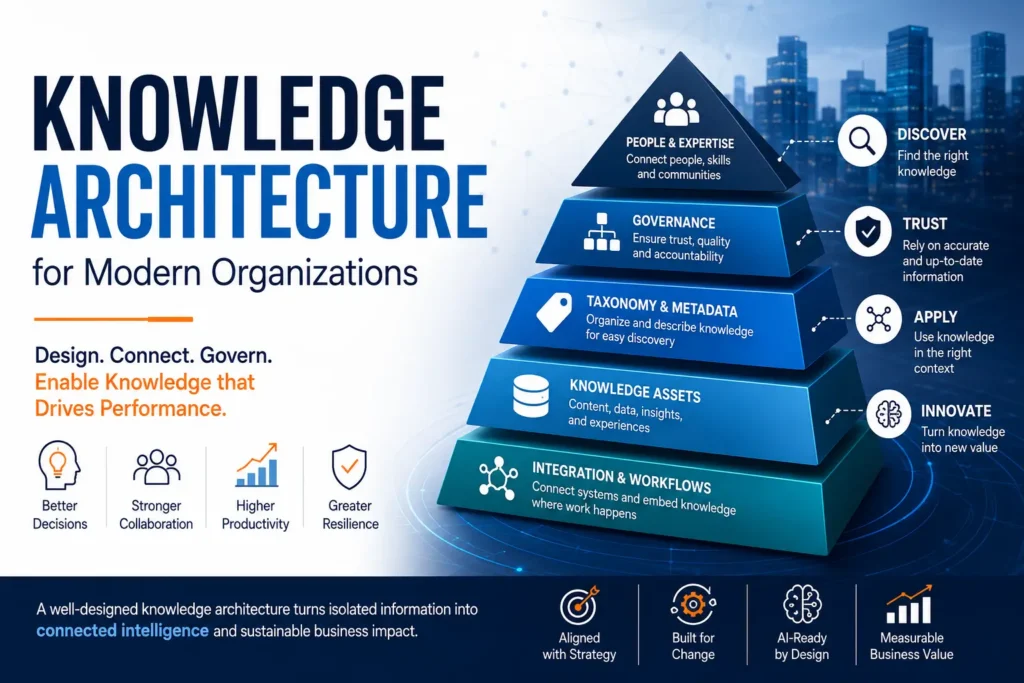
Knowledge architecture is often misunderstood because organizations tend to associate it with individual technologies rather than with the broader enterprise environment in which knowledge exists. A document management platform, enterprise search engine, knowledge base, or AI assistant may all contribute to the knowledge ecosystem, but none of these technologies represents the architecture itself. Knowledge architecture emerges from the way these capabilities interact to create a coherent environment through which organizational knowledge can move efficiently, remain trustworthy, and support business performance.
A mature knowledge architecture is built from several interconnected components rather than a single repository. Each component performs a distinct role, yet their combined effectiveness determines whether employees experience organizational knowledge as an integrated capability or as a collection of disconnected systems.
Repositories provide the foundation for preserving explicit organizational knowledge. Policies, procedures, technical documentation, project records, research reports, customer guidance, and operational standards require reliable storage throughout their lifecycle. However, repositories should not be viewed as the architecture itself. They are only one layer within a much broader environment. Organizations frequently accumulate multiple repositories over time as departments adopt specialised platforms to address local business requirements. Without an overarching architectural strategy, these repositories gradually become isolated knowledge islands that employees struggle to navigate.
Metadata provides the descriptive structure that enables knowledge to be interpreted consistently across the enterprise. Information regarding ownership, business function, lifecycle status, confidentiality, review schedules, applicability, geographic scope, and subject classification allows both employees and intelligent systems to understand the context surrounding individual knowledge assets. Well-designed metadata reduces ambiguity, improves retrieval accuracy, and supports automated governance processes. As artificial intelligence becomes increasingly integrated into enterprise knowledge environments, metadata evolves from an administrative convenience into an essential architectural component supporting semantic retrieval and contextual understanding.
Taxonomy provides the shared organisational vocabulary through which knowledge is classified and connected. Every organization develops its own language reflecting products, services, business processes, customers, regulatory requirements, and professional disciplines. When departments create independent classification schemes, similar concepts gradually become described in different ways, making enterprise-wide discovery significantly more difficult. A consistent taxonomy enables employees from different business functions to interpret knowledge within a common conceptual framework while also improving the effectiveness of enterprise search and AI-assisted retrieval.
Governance establishes the rules that maintain trust throughout the knowledge lifecycle. Ownership, approval processes, review schedules, permissions, version control, retention policies, and quality standards all contribute to ensuring that organizational knowledge remains accurate, authoritative, and reliable. Without governance, repositories inevitably accumulate outdated content, duplicate documentation, conflicting guidance, and uncertain ownership. Knowledge architecture therefore depends upon governance not merely as an administrative activity but as the mechanism that preserves confidence in enterprise knowledge over time.
Expertise networks represent another essential architectural element that organizations frequently overlook. Not every business question can be answered through documentation alone. Experienced professionals possess judgement, contextual understanding, and practical insight developed through years of operational experience. Effective knowledge architecture therefore connects knowledge assets with the people who created, maintain, or regularly apply them. Expertise directories, communities of practice, mentoring programmes, project histories, and professional networks ensure that employees can locate both documented knowledge and the specialists capable of interpreting it when necessary.
Finally, integration binds the entire knowledge architecture together. Modern organizations rarely operate within a single knowledge platform. Knowledge exists across enterprise resource planning systems, customer relationship management platforms, collaboration environments, learning systems, document repositories, research databases, operational applications, and increasingly AI-enabled services. Integration enables these environments to function as one connected knowledge ecosystem rather than isolated technology implementations. Employees should experience organizational knowledge as coherent regardless of where individual knowledge assets are physically stored.
Together, these components create an architecture that supports continuous organizational learning rather than simply preserving information. The effectiveness of knowledge architecture depends less upon the sophistication of any individual component than upon the coherence with which all components work together.
Why Poor Knowledge Architecture Creates Organizational Problems
Many organizations recognise symptoms of ineffective knowledge management without recognising their underlying architectural causes. Employees complain that information is difficult to find, project teams repeat work previously completed elsewhere, repositories become increasingly cluttered, experts receive the same questions repeatedly, and AI systems generate inconsistent responses despite extensive investments in technology. These issues often appear unrelated when examined individually. In reality, they frequently represent different manifestations of the same architectural weaknesses.
One of the most common problems is fragmentation. Knowledge gradually becomes distributed across multiple repositories created at different times for different purposes by different business functions. Individual departments optimise their own environments according to local operational requirements, but little attention is given to how those environments relate to the broader organizational knowledge landscape. Over time, employees must search numerous systems before developing confidence that they have identified the most relevant information. The organization possesses abundant knowledge, yet its distribution creates significant barriers to practical use.
Architectural inconsistency represents another common source of organizational complexity. Business units frequently adopt independent naming conventions, metadata standards, classification structures, governance processes, and terminology. Similar concepts become described using different language across departments, making enterprise-wide discovery increasingly difficult. Employees may locate several apparently relevant documents while remaining uncertain whether they describe identical concepts or entirely different practices. Artificial intelligence inherits these inconsistencies because retrieval systems depend upon coherent relationships between knowledge assets rather than isolated documents.
Poor architecture also weakens organizational memory. Valuable project experience is frequently preserved within final reports while the reasoning behind critical decisions, assumptions, stakeholder discussions, and contextual factors remain scattered across emails, meeting notes, presentations, and informal conversations. Future employees gain access to conclusions but not necessarily to the knowledge required to interpret those conclusions appropriately. Organizational learning therefore becomes increasingly fragmented despite extensive documentation.
Knowledge architecture also influences organizational resilience. Many organizations unknowingly create structural dependence upon individual experts because architectural mechanisms connecting expertise with documented knowledge remain underdeveloped. Employees rely upon experienced colleagues to interpret complex information, explain exceptions, or identify relevant historical context because repositories alone cannot provide sufficient understanding. While expert judgement remains indispensable, excessive dependence upon individuals creates organisational risk when experienced professionals retire, change roles, or leave the organization.
These architectural weaknesses become particularly visible during organizational change. Mergers, acquisitions, digital transformation programmes, regulatory change, workforce mobility, and enterprise AI initiatives all place additional pressure upon the knowledge environment. Organizations possessing coherent knowledge architecture generally adapt more effectively because knowledge remains connected, governed, and discoverable despite structural change. Organizations with fragmented architectures often experience increasing complexity because every new initiative introduces additional repositories, terminology, governance models, and technology platforms that further complicate an already fragmented environment.
The long-term consequences extend well beyond operational inefficiency. Poor knowledge architecture slows innovation because valuable ideas struggle to move across organizational boundaries. Decision-making becomes less reliable because employees cannot easily distinguish authoritative knowledge from obsolete guidance. Customer experience suffers when different parts of the organization rely upon inconsistent information. AI initiatives produce disappointing results because intelligent systems inherit the fragmentation already present within the enterprise.
These outcomes demonstrate an important principle. Organizations rarely experience knowledge problems solely because they lack information. More often, they experience architectural problems that prevent existing knowledge from functioning as an integrated organizational capability. Recognising this distinction represents the first step toward building knowledge environments capable of supporting both human expertise and the increasingly intelligent technologies that modern organizations depend upon.
Knowledge Architecture in the Age of Artificial Intelligence
Artificial intelligence has transformed knowledge architecture from a long-term organizational consideration into an immediate business priority. For many years, organizations could compensate for fragmented knowledge environments through human experience. Employees understood where information was likely to reside, knew which colleagues possessed specialist expertise, recognised which documents represented authoritative guidance, and developed informal methods for navigating organizational complexity. Although these workarounds were inefficient, they allowed organizations to function despite weaknesses in their knowledge architecture.
Artificial intelligence changes this dynamic fundamentally. Enterprise AI systems cannot rely upon institutional memory or informal professional networks in the same way experienced employees can. Their effectiveness depends almost entirely upon the quality of the knowledge architecture supporting them. Every AI-generated recommendation, summary, response, or workflow depends on the ability to retrieve relevant organizational knowledge accurately, interpret relationships correctly, respect governance requirements, and distinguish authoritative information from outdated or duplicated content.
This explains why organizations implementing similar AI technologies often achieve dramatically different outcomes. The difference rarely lies solely in the capabilities of the language model. Instead, it reflects the maturity of the underlying knowledge architecture. Organizations that have invested in consistent metadata, well-governed repositories, structured taxonomies, clear ownership, and integrated knowledge ecosystems provide AI with a reliable foundation upon which intelligent retrieval and reasoning can operate. Organizations with fragmented repositories, inconsistent terminology, duplicate documentation, and weak governance frequently discover that AI simply exposes architectural weaknesses that employees had previously managed manually.
Retrieval-Augmented Generation (RAG), semantic search, enterprise copilots, and AI agents all reinforce this dependency. These technologies are designed to retrieve organizational knowledge before generating responses. Their performance therefore depends less on the volume of available information than on the structure through which that information is organised. When knowledge assets remain disconnected, poorly classified, or difficult to interpret, retrieval quality declines regardless of how advanced the underlying language model may be.
Knowledge architecture also becomes increasingly important as organizations expand the responsibilities assigned to AI. Future enterprise systems will not simply answer questions. They will coordinate workflows, monitor policy compliance, identify subject matter experts, prepare reports, recommend operational decisions, and support increasingly complex business activities. Each of these capabilities requires trusted knowledge that has been deliberately structured to support retrieval, interpretation, governance, and contextual understanding.
For knowledge management leaders, this represents an important strategic shift. AI should not be viewed as a replacement for knowledge architecture but as a capability that depends upon it. Investments in artificial intelligence and investments in knowledge architecture are becoming increasingly interconnected because both ultimately seek to improve how organizational knowledge contributes to business performance.
Building an Effective Knowledge Architecture
Developing a mature knowledge architecture should not begin with software selection. Organizations frequently make the mistake of evaluating technology platforms before developing a clear understanding of how knowledge should function throughout the enterprise. Although technology provides important capabilities, architecture is fundamentally concerned with organisational design rather than technology procurement.
The first step involves establishing a shared understanding of organizational knowledge itself. Leaders should identify the forms of knowledge that contribute most directly to business performance, including explicit documentation, operational procedures, research findings, project experience, customer knowledge, professional expertise, regulatory guidance, and organizational memory. Each of these knowledge types follows different lifecycles, requires different governance approaches, and supports different business activities. Understanding these distinctions provides the conceptual foundation upon which architectural decisions can be made.
The second priority is developing a coherent enterprise knowledge model. Rather than allowing individual departments to organise knowledge independently, organizations should establish common taxonomies, metadata standards, terminology, ownership principles, and governance policies that support enterprise-wide consistency. This does not require every business function to use identical technologies, but it does require shared architectural principles that enable knowledge to remain connected regardless of where it resides.
Governance should be integrated into the architecture from the outset rather than introduced after repositories have already accumulated significant volumes of content. Every important knowledge asset should possess identifiable ownership, review schedules, lifecycle management processes, version control, and clearly defined authority. Governance ensures that knowledge remains trustworthy throughout its lifecycle while providing AI systems with reliable sources upon which retrieval can depend.
Organizations should also design architecture around knowledge movement rather than knowledge storage. Employees increasingly expect knowledge to appear within their workflows rather than requiring deliberate searches across multiple systems. Knowledge architecture should therefore support contextual delivery, workflow integration, enterprise search, expertise discovery, and AI-assisted retrieval. The objective is not merely to preserve organizational knowledge but to ensure that it reaches the appropriate people at the appropriate moment with minimal friction.
Continuous improvement represents another essential principle. Knowledge architecture should not be viewed as a project completed once new technology has been implemented. Organizations evolve continuously through acquisitions, regulatory changes, workforce mobility, digital transformation, new business models, and technological innovation. The architecture supporting organizational knowledge must therefore evolve alongside the business itself. Regular architectural reviews, governance assessments, taxonomy refinement, metadata improvement, and user feedback should become routine components of enterprise knowledge management.
Perhaps most importantly, organizations should recognise that effective knowledge architecture requires collaboration across multiple disciplines. Knowledge management professionals, enterprise architects, information management specialists, business leaders, digital workplace teams, data governance experts, and AI practitioners each contribute unique perspectives. Successful architecture emerges when these perspectives are integrated into a coherent enterprise strategy rather than managed as isolated initiatives.
Knowledge Architecture Is Becoming a Strategic Business Capability
Knowledge architecture has traditionally received far less executive attention than technologies such as enterprise search, collaboration platforms, artificial intelligence, or document management systems. Yet as organizations become increasingly dependent upon knowledge-intensive work, architecture is emerging as one of the most important determinants of long-term organizational performance.
Every major knowledge management challenge discussed over the past decade ultimately possesses an architectural dimension. Knowledge flow depends upon how knowledge moves between people, systems, and business processes. Knowledge friction emerges when unnecessary barriers interrupt that movement. Knowledge debt accumulates when architecture fails to support effective governance, discoverability, and lifecycle management. Organizational memory depends upon preserving knowledge within structures that future employees can interpret and apply. Artificial intelligence relies upon architecture to retrieve, understand, and govern enterprise knowledge responsibly.
These relationships demonstrate that knowledge architecture is far more than a technical framework. It represents the organisational capability through which knowledge becomes usable at enterprise scale. Well-designed architecture reduces complexity without oversimplifying organizational knowledge. It strengthens governance without restricting collaboration. It enables AI while preserving human judgement. Most importantly, it transforms isolated knowledge assets into an integrated environment that supports continuous learning, informed decision-making, innovation, and organizational resilience.
The organizations that will lead the next generation of knowledge management are unlikely to be those possessing the largest repositories or the most sophisticated technology platforms. They will be the organizations that deliberately design knowledge architectures capable of connecting people, expertise, processes, technologies, governance, and organizational memory into one coherent knowledge ecosystem.
Knowledge architecture therefore deserves to be viewed not as supporting infrastructure but as strategic infrastructure. Just as financial architecture supports investment, digital architecture supports technology, and operational architecture supports business processes, knowledge architecture supports the organization’s ability to learn, adapt, innovate, and compete in an increasingly knowledge-driven economy.
As artificial intelligence continues reshaping the future of work, organizations will discover that sustainable AI success begins long before selecting a language model or deploying a digital assistant. It begins with designing a knowledge architecture capable of supporting intelligent organisations in which both people and technology can learn from the same trusted foundation.