Organizations Do Not Suffer from a Lack of Knowledge
Modern organizations generate knowledge continuously. Every customer interaction, project, product launch, operational improvement, research initiative, and strategic decision contributes to an expanding body of organizational knowledge. Enterprise content management systems store millions of documents, collaboration platforms preserve years of conversations, project management tools record lessons learned, and knowledge bases continue to grow with every new procedure, policy, or technical article. From a purely quantitative perspective, most organizations possess more knowledge today than at any previous point in their history.
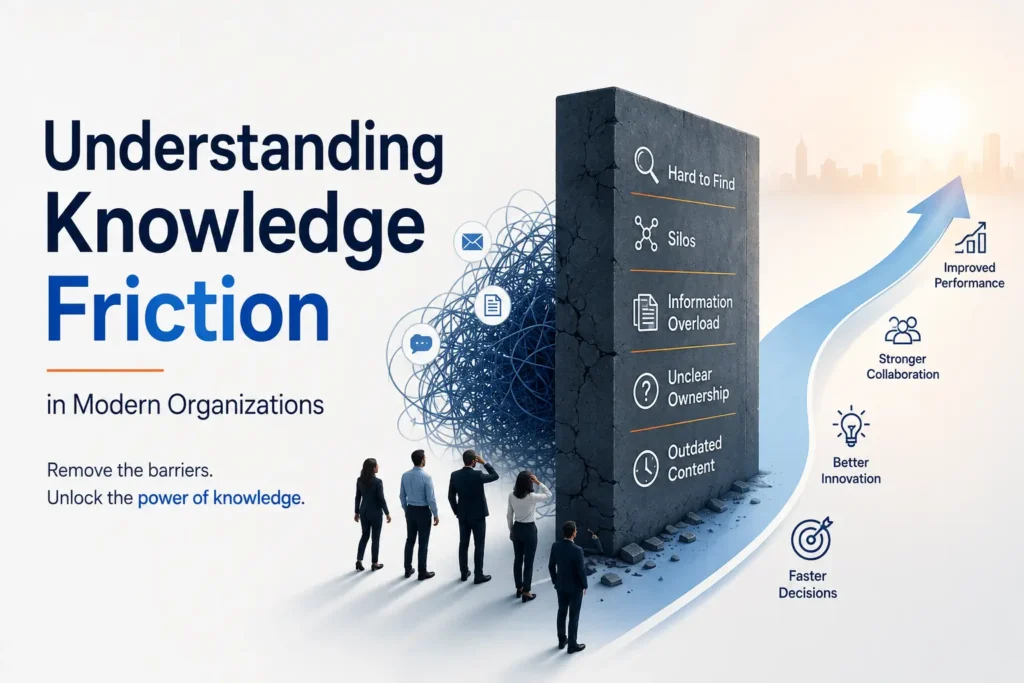
Yet despite this abundance, knowledge-intensive organizations continue to face remarkably familiar challenges. Employees spend valuable time searching for information they believe already exists. Project teams unknowingly repeat work completed elsewhere in the organization. Similar mistakes recur across different business units because previous lessons remain undiscovered. Subject matter experts receive the same questions repeatedly because their knowledge has not been effectively transferred. Important decisions are delayed while teams attempt to verify conflicting information from multiple sources. In many organizations, people often know that the answer exists somewhere, but finding the right knowledge at the right moment remains unexpectedly difficult.
These challenges reveal an important reality about knowledge management. The greatest obstacle to organizational performance is often not the absence of knowledge but the resistance that prevents knowledge from moving efficiently to where it creates value. Knowledge may exist, yet employees experience delays, interruptions, uncertainty, duplication, or unnecessary effort before they can successfully apply it. These forms of resistance collectively represent what can be described as knowledge friction.
Knowledge friction refers to the obstacles that slow, interrupt, distort, or prevent the effective movement and application of knowledge throughout an organization. Like friction in a mechanical system, it consumes energy without creating value. Employees invest additional time searching, validating, recreating, clarifying, or requesting knowledge that should already be readily available. The knowledge itself has not disappeared, but the effort required to reach and use it becomes increasingly expensive.
For many years, organizations attempted to address these problems primarily through technology. New document management systems, enterprise search platforms, collaboration tools, intranets, and more recently artificial intelligence were expected to improve access to organizational knowledge. Although these technologies have undoubtedly improved many aspects of knowledge management, they have not eliminated knowledge friction. In some cases, they have introduced entirely new forms of complexity by increasing the number of repositories, expanding the volume of available information, and creating additional pathways through which knowledge must travel.
Artificial intelligence is making this issue even more visible. Employees increasingly expect AI assistants to deliver accurate answers immediately, regardless of where organizational knowledge resides. When AI produces inconsistent or incomplete responses, organizations frequently assume the technology has failed. In reality, AI often exposes the knowledge friction that already existed within the enterprise. Fragmented repositories, inconsistent terminology, duplicated documentation, weak governance, poor metadata, and disconnected expertise all reduce the ability of AI systems to retrieve reliable organizational knowledge.
Understanding knowledge friction therefore represents a significant shift in how organizations should think about knowledge management. Instead of concentrating exclusively on creating, storing, or sharing knowledge, organizations must also examine the invisible barriers that prevent knowledge from flowing naturally across people, processes, technologies, and organizational boundaries. Removing those barriers may ultimately create greater value than producing additional knowledge.
What Is Knowledge Friction?
Knowledge friction can be understood as the cumulative resistance that reduces the speed, accuracy, and effectiveness with which knowledge moves through an organization. It represents every unnecessary obstacle that prevents employees from accessing, understanding, trusting, or applying knowledge when it is needed. These obstacles may be technical, organizational, procedural, cultural, or even cognitive, but they share one common characteristic: they increase the effort required to transform existing knowledge into organizational action.
The concept extends beyond simple information retrieval. An employee who spends thirty minutes locating a policy document experiences one form of friction. Another employee who immediately finds the document but cannot determine whether it is the latest approved version experiences a different form. A project manager who discovers three contradictory procedures from different departments encounters another type of friction, while an engineer who must interrupt a senior specialist because critical expertise has never been documented faces yet another. Although the underlying causes differ, each situation slows work, introduces uncertainty, and reduces organizational effectiveness.
Knowledge friction should therefore not be viewed merely as an inconvenience. It represents a measurable organizational cost. Every unnecessary search, repeated question, duplicated analysis, delayed decision, or recreated solution consumes time and resources that could otherwise contribute to innovation, customer value, or strategic improvement. Individually these inefficiencies may appear insignificant. Across thousands of employees and millions of daily knowledge interactions, however, they accumulate into substantial organizational expense.
Importantly, knowledge friction differs from the absence of knowledge. Organizations often assume that poor performance indicates missing information, leading them to produce more documentation, create additional repositories, or require employees to generate further reports. While these actions sometimes address genuine knowledge gaps, they frequently fail to solve the underlying problem. Employees may already possess sufficient knowledge somewhere within the organization. The real difficulty lies in moving that knowledge efficiently to where it can influence decisions and actions.
This distinction explains why organizations with extensive documentation frequently continue experiencing operational inefficiencies. The issue is not necessarily knowledge quantity but knowledge accessibility, discoverability, reliability, and contextual relevance. An organization may invest heavily in preserving knowledge while unintentionally creating conditions that make its practical use increasingly difficult.
Knowledge friction also explains why organizations sometimes perceive knowledge management as delivering less value than expected. Significant resources may be devoted to capturing knowledge, developing repositories, and implementing collaborative technologies. However, if employees continue struggling to locate trusted information quickly, the organization experiences limited improvement despite considerable investment. Reducing knowledge friction therefore becomes as important as increasing knowledge availability.
Knowledge Friction Is Different from Knowledge Flow
Knowledge flow and knowledge friction are closely related concepts, but they describe different aspects of organizational knowledge dynamics. Understanding the relationship between them helps explain why some organizations consistently transform knowledge into business value while others struggle despite possessing similar technological capabilities.
Knowledge flow describes the movement of knowledge across individuals, teams, business functions, and organizational systems. It reflects the organization’s ability to ensure that valuable knowledge reaches the right people at the right time and in the appropriate context. High levels of knowledge flow support organizational learning, faster innovation, improved collaboration, and more informed decision-making because knowledge moves efficiently across structural boundaries rather than remaining isolated within individual departments or repositories.
Knowledge friction describes the forces that resist this movement.
An organization may possess extensive knowledge assets, highly skilled employees, and sophisticated technology platforms while simultaneously experiencing significant knowledge friction. Employees may willingly share expertise, contribute documentation, and participate in collaborative initiatives, yet organizational barriers continue preventing knowledge from moving smoothly across the enterprise. Fragmented repositories, inconsistent taxonomies, excessive approval processes, duplicate documentation, incompatible systems, weak governance, and poor workflow integration all reduce knowledge flow by introducing unnecessary resistance.
The relationship between these concepts resembles the movement of water through a river system. Knowledge flow represents the movement of water itself, while knowledge friction consists of the rocks, sediment, narrow channels, and artificial barriers that slow or redirect its progress. Increasing water volume alone does not guarantee stronger flow if significant obstacles continue restricting movement. Similarly, creating additional knowledge does not necessarily improve organizational performance if friction prevents that knowledge from reaching employees who require it.
This perspective introduces an important implication for knowledge management strategy. Organizations often respond to knowledge problems by investing in additional content creation or new technology platforms. While these investments may produce valuable capabilities, they cannot fully compensate for unresolved knowledge friction. In some cases, introducing additional repositories or collaboration tools may actually increase complexity if the underlying organizational barriers remain unchanged.
Knowledge management leaders should therefore evaluate organizational performance using two complementary questions. The first asks how effectively knowledge moves throughout the enterprise. The second asks what prevents that movement from occurring more efficiently. Together, these questions shift attention from knowledge accumulation toward the overall health of the organizational knowledge ecosystem.
Understanding knowledge friction in this way encourages organizations to think beyond repositories, search engines, and collaboration platforms. It highlights the importance of organizational design, governance, leadership, workflow integration, information architecture, and culture as essential components of effective knowledge management. Ultimately, improving knowledge flow often depends less on creating additional knowledge than on systematically removing the invisible barriers that prevent existing knowledge from reaching the people who need it most.
Why Knowledge Friction Exists in Modern Organizations
Knowledge friction rarely emerges because employees are unwilling to collaborate or because organizations fail to recognize the importance of knowledge management. Most organizations actively encourage knowledge sharing, invest in digital collaboration platforms, establish communities of practice, implement enterprise search solutions, and create repositories intended to preserve institutional knowledge. Despite these efforts, friction continues to appear because it is usually an unintended consequence of organizational growth, technological complexity, evolving business processes, and human behaviour rather than the result of a single identifiable failure.
As organizations expand, they naturally develop additional business units, specialized functions, regional offices, technology platforms, governance structures, and reporting relationships. Each of these developments serves legitimate business objectives, yet collectively they increase the complexity of the organizational knowledge environment. Knowledge that once moved easily within a small team must now travel across multiple departments, technologies, approval processes, geographic locations, and professional communities before it reaches the people who need it. Every additional layer introduces opportunities for delay, duplication, misunderstanding, or loss of context.
The digital transformation of enterprises has also contributed to this complexity. Modern employees work across collaboration platforms, document management systems, enterprise resource planning applications, customer relationship management systems, learning management platforms, project management tools, messaging applications, shared drives, cloud repositories, and increasingly AI-enabled workspaces. Each system manages information effectively within its own domain, but employees rarely experience them as one connected knowledge environment. Instead, organizational knowledge becomes distributed across multiple locations that often lack consistent metadata, governance, ownership, or retrieval mechanisms.
Artificial intelligence has amplified awareness of these issues. Employees increasingly expect AI systems to retrieve relevant knowledge regardless of where it resides. When intelligent assistants struggle to generate accurate responses, the underlying problem is frequently not the language model itself but the fragmented knowledge landscape supporting it. AI reveals the organizational complexity that employees have quietly navigated for years.
Knowledge friction therefore represents an organizational characteristic rather than an isolated operational problem. It emerges naturally whenever knowledge must move through increasingly complex systems that were not designed with integrated knowledge flow as a primary objective. Reducing friction requires organizations to understand not only where knowledge exists but also how organizational structures influence its movement.
Organizational Silos Slow the Movement of Knowledge
One of the most persistent sources of knowledge friction is the existence of organizational silos. As enterprises grow, specialization becomes necessary. Business units develop expertise in specific domains, establish independent processes, adopt specialized technologies, and optimize performance according to their own objectives. While specialization improves operational efficiency within individual functions, it frequently reduces the movement of knowledge across organizational boundaries.
Knowledge rarely follows organizational charts. Customer challenges span multiple departments, innovation often emerges through interdisciplinary collaboration, operational improvements require shared learning, and strategic decisions benefit from diverse perspectives. Yet organizational structures frequently encourage knowledge to remain within functional boundaries. Marketing develops insights that product development rarely accesses. Customer support accumulates valuable operational knowledge that fails to influence product design. Regional offices solve similar problems independently because successful practices remain invisible beyond local teams.
These silos are rarely created intentionally. They emerge because organizations naturally optimize communication within teams rather than across teams. Employees build trusted professional networks inside their own departments, participate in function-specific meetings, use terminology familiar to their immediate colleagues, and prioritise local performance objectives. Over time, these patterns create knowledge environments that function effectively internally while remaining increasingly disconnected from the broader enterprise.
Technology can unintentionally reinforce this separation. Different departments often adopt different platforms, document structures, metadata standards, and classification systems. Although each environment may function well independently, the absence of consistent knowledge architecture makes enterprise-wide discovery significantly more difficult. Employees searching beyond their own function frequently encounter unfamiliar terminology, duplicated information, inconsistent governance, and uncertainty regarding which source should be considered authoritative.
Reducing knowledge friction therefore requires organizations to think beyond departmental optimization. Knowledge management should strengthen the connections between organizational communities rather than simply improving knowledge within individual business units. Communities of practice, cross-functional projects, enterprise taxonomies, integrated search capabilities, shared governance models, and common metadata standards all contribute to reducing the invisible barriers that organizational silos create.
Organizations that deliberately design for cross-functional knowledge movement consistently outperform those that rely solely on local optimization because innovation, learning, and decision-making increasingly depend upon knowledge flowing across traditional organizational boundaries.
Information Overload Creates Decision Friction
Knowledge management has traditionally focused on preserving organizational knowledge because information loss represented a significant business risk. Today, many organizations face the opposite challenge. Instead of lacking information, employees are overwhelmed by its volume.
Every day, organizations generate emails, presentations, reports, technical documentation, project updates, policies, research papers, collaboration messages, customer records, dashboards, videos, meeting transcripts, AI-generated summaries, and countless other knowledge assets. Although each individual item may have legitimate value, their combined volume creates an environment in which identifying genuinely relevant knowledge becomes increasingly difficult.
Information overload should not be confused with knowledge abundance. More information does not necessarily improve decision quality. In many cases it produces the opposite effect by increasing the effort required to distinguish important knowledge from routine communication, outdated content, duplicated documentation, or irrelevant detail.
This creates a subtle but important form of knowledge friction. Employees may successfully retrieve dozens of relevant documents while still struggling to determine which one should guide action. Time that should be devoted to solving business problems becomes consumed by evaluating competing sources, comparing versions, validating accuracy, and interpreting conflicting guidance. The knowledge technically exists, yet the effort required to transform it into confident decision-making continues to increase.
Artificial intelligence offers significant opportunities to reduce information overload through summarisation, semantic retrieval, conversational search, and contextual recommendations. However, AI does not eliminate the underlying challenge if the knowledge environment itself remains poorly governed. When multiple outdated procedures exist, AI may retrieve several conflicting sources. When metadata is inconsistent, retrieval quality declines. When authoritative ownership has not been established, summarisation alone cannot determine which guidance should govern organisational action.
Organizations therefore need to recognise that managing information volume and managing knowledge quality are different responsibilities. Reducing knowledge friction requires not only helping employees locate information but also helping them identify which knowledge deserves trust. Without this distinction, information abundance gradually becomes another source of organizational complexity rather than a strategic advantage.
Poor Knowledge Architecture Increases Organizational Complexity
Knowledge architecture receives considerably less attention than technology selection, yet it frequently determines whether organizational knowledge remains usable over time. Every enterprise possesses an architecture whether it has been deliberately designed or has evolved gradually through years of independent technology implementations, departmental growth, and changing business priorities.
Poor knowledge architecture introduces friction because it forces employees to understand the structure of organizational systems before they can understand the knowledge contained within them. Instead of focusing on solving business problems, employees devote significant effort to determining where information resides, how repositories are organised, which taxonomy applies to a particular business unit, and which version of similar content should be considered authoritative.
This complexity often develops incrementally. New repositories are introduced for legitimate operational reasons. Departments create local classification systems that reflect specialised terminology. Business acquisitions introduce additional knowledge structures. Legacy systems remain operational alongside modern platforms because migration appears costly or disruptive. Over time, the organization accumulates multiple overlapping knowledge environments that individually appear manageable but collectively become increasingly difficult to navigate.
Knowledge architecture extends far beyond repository design. It includes taxonomy, metadata, content relationships, ownership models, governance structures, terminology management, identity integration, security models, lifecycle management, and retrieval design. These elements determine how effectively knowledge can move across the enterprise regardless of where it is physically stored.
Artificial intelligence reinforces the importance of architecture because retrieval systems depend upon meaningful relationships between knowledge assets. Semantic search, Retrieval-Augmented Generation, knowledge graphs, and AI assistants all perform more effectively when organizational knowledge has been deliberately structured rather than simply accumulated. Poor architecture introduces ambiguity that AI systems cannot consistently resolve without stronger organizational governance.
Organizations frequently invest substantial resources implementing advanced knowledge technologies while overlooking the architectural foundations upon which those technologies depend. In reality, architecture determines whether enterprise knowledge remains discoverable, trustworthy, and connected as the organization continues to evolve. Reducing knowledge friction therefore requires long-term investment in architectural coherence rather than continuous expansion of isolated knowledge platforms.
Knowledge Friction in the Age of Artificial Intelligence
Artificial intelligence has fundamentally altered how employees expect to interact with organizational knowledge. For decades, knowledge workers accepted that finding reliable information required effort. They searched multiple repositories, consulted experienced colleagues, compared different versions of documents, and often spent considerable time validating information before acting upon it. Although this process was inefficient, it became an accepted characteristic of knowledge work.
Generative AI has changed those expectations almost overnight. Employees increasingly expect conversational systems to provide accurate, contextual, and trustworthy answers regardless of where organizational knowledge resides. From the user’s perspective, the complexity of the underlying knowledge environment should no longer matter. The expectation is simple: ask a question and receive the correct answer.
This shift has significant implications for knowledge management because artificial intelligence exposes organizational knowledge friction more clearly than previous technologies. Traditional search systems returned documents, leaving employees responsible for interpreting conflicting information. AI attempts to produce a single coherent response, making weaknesses within the knowledge environment immediately visible. Fragmented repositories, duplicate documentation, inconsistent terminology, outdated procedures, missing metadata, and unclear ownership all reduce the quality of AI-generated responses because retrieval systems depend upon the quality of the knowledge they retrieve.
Many organizations initially interpret disappointing AI performance as a limitation of the language model itself. In practice, the underlying problem frequently lies elsewhere. Artificial intelligence cannot consistently distinguish between competing versions of knowledge if governance has never established an authoritative source. It cannot infer organisational context that has never been documented. It cannot reliably identify subject matter experts when expertise remains hidden within organisational networks. AI therefore acts less as a solution to knowledge friction than as a diagnostic instrument that reveals where friction already exists.
This perspective should encourage organizations to reconsider AI readiness. Rather than asking whether the latest AI technology has been implemented successfully, leaders should examine whether their knowledge environment enables reliable retrieval, contextual understanding, and trustworthy knowledge application. AI maturity increasingly depends upon knowledge maturity. Organizations that reduce knowledge friction before expanding AI capabilities will generally achieve significantly better outcomes than those attempting to compensate for poor knowledge management through increasingly sophisticated technology.
Artificial intelligence therefore reinforces one of the central principles of modern knowledge management. Technology accelerates the movement of knowledge, but it cannot compensate indefinitely for weaknesses in the organizational systems through which knowledge moves.
Read: How to Improve Your Knowledge Management Strategy for AI
Reducing Knowledge Friction Requires Organizational Design
Knowledge friction is often addressed through isolated technology initiatives. Organizations purchase new enterprise search platforms, implement collaboration tools, deploy AI assistants, or introduce additional repositories with the expectation that better software will solve existing knowledge problems. Although technological improvements can certainly reduce specific forms of friction, they rarely eliminate the broader organizational conditions from which friction emerges.
Reducing knowledge friction requires organizations to view knowledge as an organizational capability rather than simply an information resource. Knowledge moves through relationships, governance structures, workflows, technologies, leadership behaviours, communities, and organisational culture simultaneously. Improving only one element while ignoring the others frequently shifts friction rather than removing it.
One of the most effective approaches begins with simplifying knowledge architecture. Employees should not need to understand the internal structure of multiple enterprise systems before locating reliable knowledge. Consistent metadata, shared taxonomies, common terminology, integrated retrieval mechanisms, and clearly defined ownership reduce unnecessary complexity while improving both human discovery and AI retrieval.
Governance also plays an essential role. Every important knowledge asset should possess identifiable ownership, defined review cycles, lifecycle management, and clear authority. Governance should not be viewed as administrative overhead but as the mechanism through which organizations preserve trust in enterprise knowledge. Employees act more confidently when they know information has been validated, maintained, and approved by accountable subject matter experts.
Organizations should also strengthen cross-functional knowledge movement. Communities of practice, interdisciplinary projects, structured after-action reviews, mentoring programmes, and enterprise-wide collaboration initiatives help knowledge move beyond departmental boundaries where it can influence broader organizational performance. These mechanisms reduce friction not by producing more knowledge but by enabling existing knowledge to travel more effectively.
Workflow integration provides another significant opportunity. Knowledge creates the greatest value when it appears naturally within business processes rather than requiring employees to interrupt their work to search separate systems. Contextual knowledge delivery, embedded guidance, intelligent recommendations, and workflow-aware AI assistants all reduce the effort required to transform knowledge into action. The objective is not merely to improve retrieval but to minimise the distance between organizational knowledge and organizational decision-making.
Finally, organizations should recognise that reducing knowledge friction requires continuous improvement rather than periodic clean-up initiatives. Every new project, acquisition, technology implementation, policy revision, and organisational change introduces opportunities for additional friction. Knowledge management therefore becomes an ongoing process of identifying, measuring, and removing barriers that gradually emerge as the enterprise evolves.
Measuring Knowledge Friction
Organizations frequently invest considerable resources improving knowledge management without establishing reliable methods for determining whether knowledge has actually become easier to use. Traditional KM metrics such as repository size, document contributions, page views, and downloads provide useful operational information, but they reveal relatively little about the level of friction employees experience during everyday knowledge work.
Knowledge friction should instead be evaluated through measures that reflect the effort required to transform organizational knowledge into effective action. Search time provides one useful indicator because excessive time locating information often signals fragmentation, poor metadata, or ineffective retrieval architecture. Equally important is search success. Employees may locate information quickly while still lacking confidence that the retrieved knowledge represents the correct or most current guidance.
Organizations should also examine duplication of effort. Repeated analyses, independently recreated documentation, recurring project mistakes, and multiple departments solving similar problems frequently indicate that knowledge is not moving effectively across the enterprise. These patterns often reveal friction more clearly than repository statistics because they demonstrate where organizational learning has failed to influence future work.
Expert dependency represents another important indicator. When a small number of specialists continue answering routine questions that could reasonably be supported through better knowledge management, organizations should investigate whether friction is preventing expertise from becoming organisational capability. High dependence on individual experts often indicates weaknesses in knowledge transfer, discoverability, or contextual documentation rather than shortages of expertise itself.
Artificial intelligence introduces additional opportunities for measurement. Retrieval precision, citation quality, unanswered questions, user confidence, correction frequency, and AI feedback mechanisms all provide valuable evidence regarding the health of the underlying knowledge environment. Rather than evaluating AI solely according to technical performance, organizations should interpret these measures as indicators of knowledge friction within the enterprise.
The purpose of measurement is not to produce additional dashboards but to identify where organizational energy is being consumed unnecessarily. Every reduction in friction enables employees to spend less time searching, validating, clarifying, or recreating knowledge and more time applying it to create value.
Knowledge Friction Is an Invisible Cost of Organizational Performance
Many organizational inefficiencies that appear unrelated to knowledge management can ultimately be traced to knowledge friction. Slow decision-making, repeated operational mistakes, inconsistent customer experiences, delayed innovation, extended onboarding periods, duplicated work, and disappointing AI implementations frequently share a common underlying characteristic. Valuable organizational knowledge exists, yet unnecessary barriers prevent that knowledge from reaching the people who need it when they need it.
This observation has important implications for senior leaders. Investments in knowledge management should not be evaluated solely according to the number of repositories implemented or documents published. Their real value lies in reducing the resistance that separates organizational knowledge from organizational action. Every improvement that reduces search effort, increases trust, strengthens discoverability, improves governance, connects expertise, or simplifies knowledge architecture contributes directly to organizational performance.
Knowledge friction also changes how organizations should think about competitive advantage. In an increasingly knowledge-intensive economy, success depends less on possessing information than on enabling knowledge to move more effectively than competitors. Organizations capable of transferring expertise rapidly, learning continuously, and connecting knowledge across functional boundaries adapt more quickly to changing markets because valuable knowledge encounters fewer barriers as it travels throughout the enterprise.
Artificial intelligence makes this challenge even more significant. Future AI systems will increasingly depend upon trusted enterprise knowledge to support decision-making, workflow automation, and intelligent assistance. Organizations that reduce knowledge friction today will establish stronger foundations for future AI capabilities because intelligent systems perform best when organizational knowledge is connected, governed, contextual, and discoverable.
Knowledge management has traditionally focused on creating, preserving, and sharing knowledge. Those responsibilities remain essential. However, the next stage in the discipline’s evolution may be equally concerned with identifying and removing the invisible forces that prevent knowledge from creating value. Understanding knowledge friction provides a framework for recognising those forces and designing organizations in which knowledge moves with greater speed, accuracy, and purpose.
The most successful organizations of the coming decade will not necessarily be those that generate the greatest quantity of knowledge. They will be the organizations that systematically reduce the resistance preventing knowledge from becoming action.