
Organizations Rarely Fail Because They Lack Knowledge
Modern organizations possess more knowledge than at any other point in history. Every project generates documentation, every customer interaction produces data, every meeting creates records, and every digital platform contributes additional information to an expanding organizational memory. Enterprise knowledge bases continue to grow, collaboration platforms preserve years of conversations, document management systems store millions of files, and artificial intelligence now makes it possible to retrieve and summarize information within seconds. On the surface, it would appear that organizations have largely solved the problem of knowledge availability.
Yet the reality inside many enterprises tells a different story.
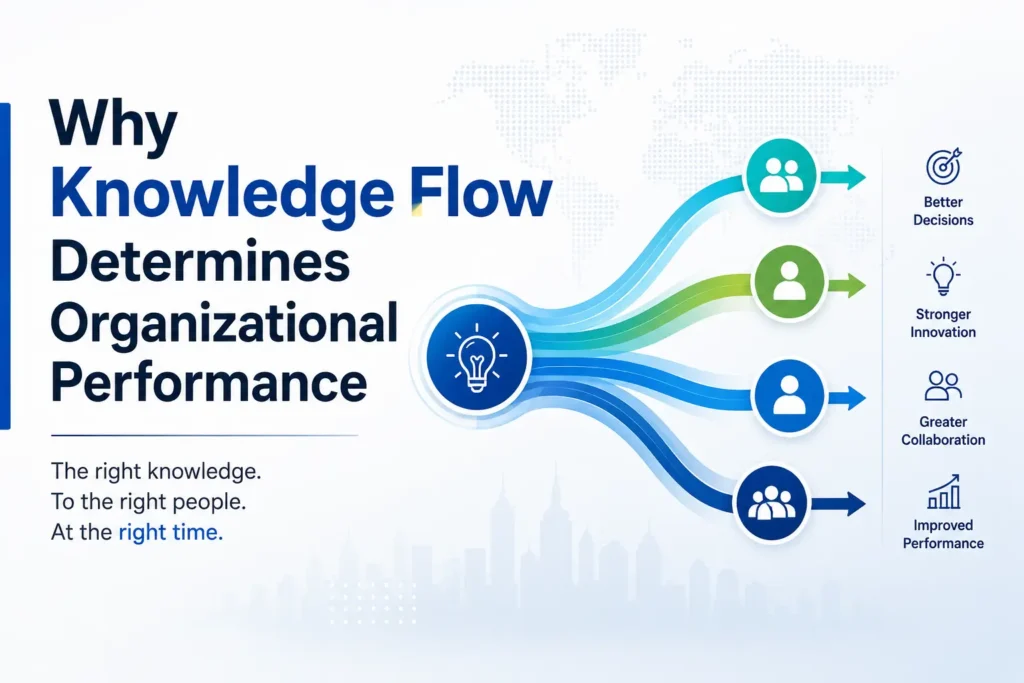
Employees continue to spend significant amounts of time searching for information that should already exist. Project teams unknowingly repeat work completed elsewhere in the organization. Similar mistakes recur despite previous lessons being documented. Specialists are repeatedly interrupted because critical expertise remains concentrated within a small number of individuals. Business units develop solutions independently because they remain unaware of work happening in parallel elsewhere. Executives make strategic decisions without access to relevant organizational experience that already exists somewhere inside the enterprise.
These situations do not occur because organizations lack knowledge. They occur because knowledge does not move effectively.
For decades, knowledge management has concentrated heavily on knowledge creation, capture, storage, retention, and sharing. These activities remain fundamental, but they represent only part of the organizational knowledge equation. Knowledge generates value only when it reaches the people who need it, at the moment they need it, in a form they can understand and apply. Between knowledge creation and knowledge application lies a critical process that many organizations continue to underestimate: knowledge flow.
Knowledge flow describes the movement of knowledge across people, teams, functions, technologies, and organizational boundaries. It explains how ideas spread, how expertise becomes available beyond individual specialists, how lessons learned influence future work, how innovation scales across business units, and how organizational intelligence develops over time. Knowledge that remains isolated within repositories, departments, or individual experts may still exist, but from an organizational perspective it contributes remarkably little value.
Artificial intelligence is making this reality increasingly visible. AI systems depend upon knowledge that can be discovered, interpreted, connected, and trusted. When knowledge flows efficiently, AI becomes substantially more effective. When knowledge remains fragmented, duplicated, or inaccessible, even the most sophisticated AI technologies struggle to produce reliable outcomes. This demonstrates an important principle that extends well beyond artificial intelligence itself. Organizational performance depends not only on what the organization knows, but also on how effectively that knowledge moves.
Understanding knowledge flow therefore requires a shift in perspective. The objective of knowledge management is not simply to build larger repositories or encourage more knowledge sharing. It is to design organizations in which valuable knowledge moves naturally toward the places where it creates the greatest business value.
Knowledge Is Valuable Only When It Moves
Organizations have traditionally treated knowledge as an asset that can be accumulated. Strategic plans frequently emphasize building knowledge repositories, preserving critical expertise, documenting best practices, and capturing lessons learned before experienced employees retire. These initiatives remain important because organizations cannot reuse knowledge that has never been preserved. However, preservation alone does not create organizational capability.
A technical procedure stored in a repository contributes little value if engineers remain unaware of its existence. A comprehensive lessons learned database produces limited benefit when project managers cannot discover relevant experience during project planning. A highly experienced specialist contributes only partially to organizational capability when colleagues depend exclusively upon informal conversations rather than systematic knowledge transfer. In each of these situations, knowledge exists but does not flow.
The distinction between knowledge availability and knowledge movement is significant. Availability answers the question of whether knowledge exists somewhere within the organization. Knowledge flow answers a much more important question: can the right knowledge reach the right people quickly enough to improve decisions, reduce risk, and increase organizational performance?
This perspective helps explain why many organizations continue to experience knowledge-related problems despite substantial investments in technology. Repositories improve storage. Search engines improve retrieval. Collaboration platforms improve communication. None of these technologies automatically guarantee that valuable knowledge will move effectively across organizational boundaries. Movement depends equally upon organizational culture, governance, incentives, workflow integration, leadership behaviour, information architecture, and social relationships.
Knowledge flow should therefore be understood as an organizational capability rather than a technological feature. It reflects the degree to which knowledge can travel across formal structures without unnecessary delay, distortion, duplication, or loss of context. Organizations with strong knowledge flow tend to adapt more quickly because successful practices spread efficiently, expertise becomes easier to locate, and learning accumulates continuously rather than remaining isolated within individual teams. Organizations with weak knowledge flow often experience repeated reinvention, inconsistent decision-making, duplicated effort, and slower organizational learning despite possessing considerable knowledge assets.
This distinction is becoming increasingly important as organizations become larger, more geographically distributed, and more digitally connected. The challenge is no longer generating knowledge. Most enterprises produce knowledge continuously. The challenge is ensuring that knowledge moves with sufficient speed, accuracy, and context to support organizational action.
Knowledge Flow Is Different from Knowledge Sharing
The terms knowledge flow and knowledge sharing are often used interchangeably, yet they describe different organizational phenomena. Knowledge sharing typically refers to deliberate activities through which individuals exchange information, experience, or expertise. Employees contribute documents to repositories, participate in communities of practice, mentor colleagues, present lessons learned, or collaborate during projects. These activities represent valuable mechanisms for transferring knowledge between people.
Knowledge flow represents the broader system within which these interactions occur.
An organization may encourage knowledge sharing while still experiencing poor knowledge flow. Employees may willingly contribute documents, participate enthusiastically in collaborative initiatives, and support communities of practice, yet valuable knowledge may continue to move slowly because repositories remain fragmented, taxonomies are inconsistent, governance is weak, or organizational silos limit cross-functional communication. Sharing describes an action. Flow describes the overall effectiveness of the organizational knowledge system.
The distinction resembles transportation infrastructure within a city. Individual drivers may be highly cooperative, follow traffic regulations, and willingly travel wherever necessary. Nevertheless, if the road network contains significant bottlenecks, poor connections, inadequate planning, or outdated infrastructure, traffic will continue moving inefficiently. The willingness of individuals to participate cannot compensate entirely for weaknesses within the broader system.
Knowledge behaves similarly. Individual employees may demonstrate excellent knowledge-sharing behaviour while organizational structures continue to impede the movement of knowledge toward areas where it could create value. Functional boundaries, incompatible technologies, inconsistent terminology, duplicated repositories, excessive approval processes, unclear ownership, and limited visibility of expertise all reduce organizational knowledge flow regardless of individual willingness to collaborate.
Viewing knowledge management through the lens of knowledge flow therefore broadens the scope of strategic thinking. The objective shifts from encouraging more knowledge sharing toward designing organizational environments in which knowledge moves naturally across formal structures. This perspective encourages leaders to examine organizational architecture, governance models, digital ecosystems, workflow design, and cultural norms as interconnected elements influencing the movement of knowledge throughout the enterprise.
It also highlights why measuring contribution alone provides an incomplete understanding of KM performance. Organizations should not simply ask how much knowledge employees contribute. They should ask whether that knowledge successfully reaches people who can use it, whether it influences future decisions, and whether it continues moving throughout the organization rather than becoming trapped within isolated repositories.
Knowledge sharing remains one of the mechanisms that enables knowledge flow.
Knowledge flow, however, represents the organizational outcome that knowledge management ultimately seeks to achieve.