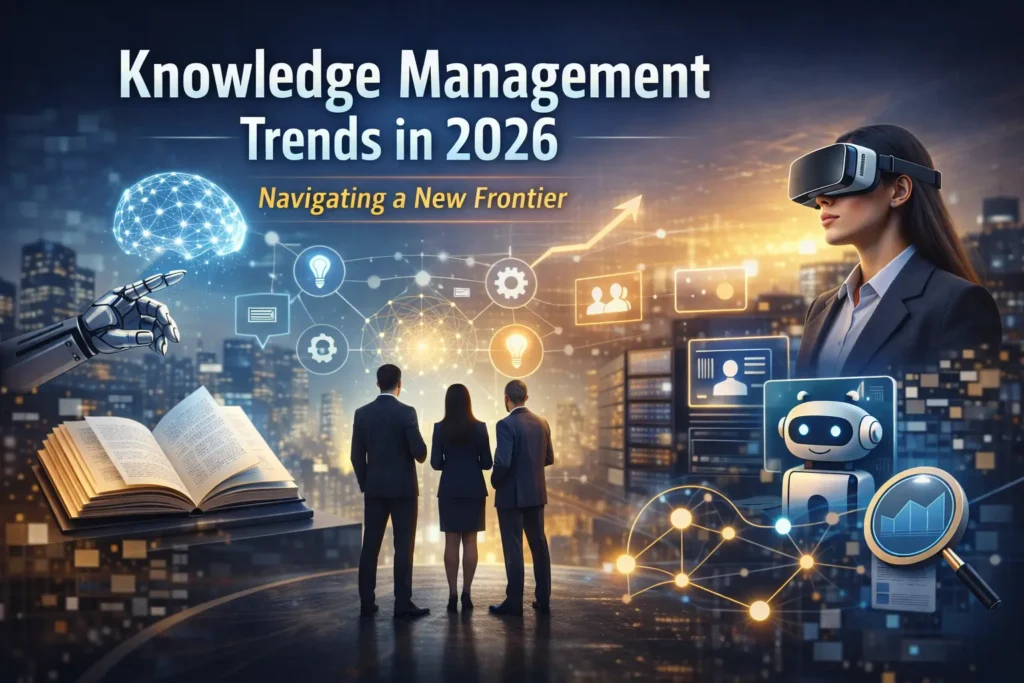
As 2026 begins, knowledge management has already crossed a quiet but important threshold. What were once incremental improvements to systems and repositories have become clear knowledge management trends that are reshaping how organizations operate, decide, and compete. Knowledge management is no longer defined by intranets or content accumulation, but by its ability to convert distributed expertise into timely, usable insight. In practical terms, this shift supports faster decision-making, sustained innovation, and stronger risk control. KM professionals are living through this transition in real time. Some organizations remain constrained by fragmented information and slow retrieval, while others are moving ahead by treating knowledge as a living organizational asset. The year ahead leaves little room for hesitation; the gap between these approaches is widening, and its consequences are increasingly visible.
In this piece we’ll explore the big shifts ahead technological and cultural, and what they mean for real people on the ground. We’ll look at how artificial intelligence is changing KM, how collaboration must evolve for hybrid teams, why capturing tacit know-how is urgent as people move on, how raw data is being turned into knowledge, and why employee experience and ROI finally matter. Think of this as advice from someone who’s ridden the roller coaster of KM change – honest, practical, and backed by what the latest research tells us.

Building AI-Ready Knowledge Foundations
One of the loudest shifts is AI integration. By 2026, almost every KM system will have some AI or machine learning under the hood. But there’s a big catch: AI is only as smart as the knowledge it’s fed. The American Productivity & Quality Center (APQC) warns that organizations need to invest in “structured, high-quality knowledge assets” – breaking down silos and setting clear content standards – so that AI can learn from reliable information. In plain terms, don’t expect generative AI to spit out great answers if your content is a jumbled mess. We’ve all seen chatbots hallucinate nonsense when the source material is poor.
On the plus side, AI can automate the busywork. KM teams are already using machine learning to sort files, tag documents, and clean up data. Imagine having an AI “librarian” who constantly monitors usage and flags outdated pages or missing guides. As one expert notes, tools will soon be able to “predict gaps in your knowledge base and recommend updates” by watching how people search and click. Generative AI goes further – summarizing long manuals, drafting new FAQs, or translating content into different languages – so that KM content stays fresh without drowning staff in tedious updates. In fact, one KM analysis found that GenAI is no longer a novelty but a standard part of knowledge bases, capable of summarizing complex documents and even tailoring content to different audiences.
All that said, humans still matter. As one APQC blogger puts it, “AI can automate a lot, but it can’t replace human judgment.” The smart strategy is to embed AI into everyday workflows while keeping employees in the loop. In practice, that means let AI suggest an answer or draft a proposal – but make sure a person reviews it, asks clarifying questions, and adds nuance. The goal is balance: use automation to save time, and use human wisdom to ensure quality. When AI models do misinterpret things (and they will), it’s our job to catch those errors with domain knowledge.
It’s also worth noting that AI governance will become a key trend. As generative models produce more content, leaders must ensure AI is transparent and ethical. For example, the new EU AI Act and other regulations demand explainable outputs. KM experts advise appointing roles like “AI Knowledge Ethicist” to oversee how AI is used in knowledge tools. In short, plan now for rules and checks around your AI-powered KM.
Collaboration and Communities in a Hybrid World
Another big shift is how people work and share knowledge. The pandemic left us with distributed teams as the new normal. In 2026, KM must fit seamlessly into a hybrid environment. Gone are the days when everyone sits around the same table. Instead, knowledge needs to flow through chat channels, video calls, and collaboration platforms.
Modern KM systems are evolving accordingly. For example, platforms now often come with built-in real-time editing, discussion threads, and integrated chat so that “teams can exchange ideas the moment they arise and build on each other’s expertise”. Instead of emailing a document around, colleagues can co-author wiki pages or comment on answers in a shared portal. All conversations and decisions are kept in one place. This one-stop approach speeds problem solving and creates a more resilient knowledge ecosystem – a huge advantage when teams are spread across time zones.
We’re also seeing the revival of Communities of Practice and social networks – but with a digital upgrade. APQC predicts that by 2026 we’ll have “hybrid, AI-assisted networks where people share tacit knowledge, and AI becomes another community member to help surface insights”. In practical terms, imagine a professional community where an AI bot listens in on discussions and summarizes key points, or suggests related expertise from elsewhere in the company. This kind of intelligent community connects people across departments and geographies. It’s like having a colleague who never sleeps, quietly learning from every conversation.
That said, these digital communities still need human curation. Leaders and KM pros must nurture trust and engagement – technology can’t force people to share what they know. We’ve learned that the most innovative organizations are those where knowledge sharing is part of the culture. In other words, build the will alongside the skill.
Finally, hybrid work and KM go hand in hand in the tools we choose. Integrations with platforms like Slack, Microsoft Teams, or Zoom are a must. Today’s knowledge solutions embed answers right where people work. For example, an AI assistant might pop up in chat to offer help based on ongoing conversation, or automatically attach a relevant FAQ to a ticket in a project management tool. The idea is to reduce friction: don’t make people click away to another site just to find a document. Embed knowledge in the flow of daily work, and people will use it.
Capturing and Retaining Critical Know-How
A cultural and strategic challenge is knowledge retention amid turnover. Every time an experienced employee quits or retires, a piece of tribal know-how can walk out the door. With accelerating retirements and gig work, this risk has never been higher. APQC is blunt: organizations must get serious about capturing critical knowledge “before it walks out the door”.
What does that mean? It means having processes to extract wisdom from people while you still can. Some of this is formal: mentoring programs, thorough exit interviews, “last lecture” sessions. But a lot of it is informal and continuous. Experts talk about collecting tacit knowledge – the intuition, tricks of the trade, and hard-earned lessons that don’t fit neatly into manuals. XWiki defines tacit knowledge as “the know-how, experiences, and intuitive knowledge” in people’s heads. It’s the senior engineer’s gut-feel or the customer rep’s personal approach. By definition, it’s hard to document.
Luckily, 2026 tools are getting better at capturing it. Simple features like voice notes, comments, and tags can let people record small insights as they happen. For example, a field service tech might record a quick video on how she bypasses a stubborn error code. Or a designer might annotate a blueprint with a clue only they would have thought of. These bite-sized contributions add up. An AI component can even transcribe meeting recordings or suggest filling in Q&A pages based on what it hears. According to industry reports, AI-driven tools are now automating “the capture of tribal knowledge through document analysis, meeting transcripts, and workflow tracking”. In practice, this means less information slips through the cracks.
The payoff is huge. Data from Bloomfire (a KM platform vendor) shows that with strong knowledge management, subject-matter experts get back about 4.5% more time per week for high-value work – time they can spend sharing their expertise rather than answering the same questions over and over. In fact, 84% of organizations using these tools say they feel more confident about retaining knowledge during staff transitions. These are not trivial gains – they translate into millions in productivity.
In short, make knowledge capture an everyday habit. Create roles like Knowledge Curator or KM Coach if you can, and map out who knows what. When a veteran on your team starts to leave, don’t scramble – you already have plans to interview them and archive their key insights. And remember, some of the richest knowledge comes out in conversation: foster forums, wikis, or chat groups where experts feel safe to teach others. Every company is losing expertise – the ones that win in 2026 will be those who catch it first.
From Data to Decision: Analytics and AI-Driven Insights
By 2026 we also expect a major shift from data to knowledge. In the past, organizations collected mountains of data and content but often struggled to turn it into understanding. Today, advanced analytics and AI are closing that gap. Modern KM platforms don’t just store documents – they analyze how those documents are used. This is where knowledge management analytics come in.
Think of analytics as the feedback loop of KM. Every search query, every article view, every unanswered question tells a story. XWiki explains that in 2026 KM analytics will be a must-have for truly data-driven decisions. By examining usage patterns, leaders can spot where knowledge gaps exist and fix them. For example, if many people search for something that isn’t in the knowledge base, that alerts us to create a new FAQ or training. Analytics also enable personalization: the system can start to recommend resources based on someone’s role, past behavior, or projects.
Underneath that, new technologies like semantic search and natural language processing are making search much smarter. Instead of matching keywords, systems use AI to understand intent. This means employees can ask questions in plain English (“How do I reset the VPN?”) and get the right answer, even if the exact phrase is not in the documents. These tools can crawl both structured data (like databases) and unstructured info (like video transcripts) at once, surfacing connections that used to be hidden.
The impact on innovation can be dramatic. For instance, industries like pharmaceuticals are using AI-powered KM to speed research and development. Special systems comb through scientific papers, patents, and lab notes to spot trends or suggest new product ideas. One report notes that in pharma, an AI-driven KM solution can “analyze vast datasets… to spot trends, foster innovation, and accelerate product development”. In other words, knowledge management becomes not just a back-office tool but a competitive weapon for growth.
Behind the scenes, these innovations also push data management forward. Some companies are building internal knowledge graphs to link concepts, products, and processes, turning raw data into rich networks of insight. Others enforce “smart data valuation,” using AI to decide which data sets are truly valuable to keep around. All of this shifts the mindset: we don’t just manage documents, we manage information ecosystems.
Finally, integrating KM with other systems is key. Think of enterprise intelligence as the synergy of KM + search + business intelligence + AI. When these are stitched together, APQC data suggests, you can cut time-to-insight in half and unlock major revenue gains. The more your KM platform connects with CRM, HR, and operations data, the more context it has to help employees make decisions. The goal is to have the answer pop up exactly when and where it’s needed – turning a chaotic heap of data into the right knowledge at the right moment.
Putting People First: Knowledge for a Better Employee Experience
All this technology also ties back to employee experience. Knowledge management isn’t just for saving the CEO time or automating support – it’s about making every person’s workday smoother. A key trend for 2026 is treating KM as part of the employee experience strategy. High-quality KM systems become a source of engagement and even comfort, much like internal social networks or wellness apps do.
Practically, this means KM tools must be user-friendly, personalized, and integrated. Experts say improving the employee experience will be a top priority Gone are the days of a clunky intranet that only techies can navigate. Instead, imagine a system that knows who you are: it serves up tutorials and docs relevant to your role, project, or even your last searches. AI plays a role here too – chatbots and virtual assistants can answer routine questions instantly. The result is less frustration and lost time hunting for answers.
For example, your customer support team might have an AI-driven chat window that suggests knowledge base articles as soon as a ticket is opened. A sales rep could see product updates in their CRM automatically. By reducing friction, we free employees to focus on interesting work instead of busywork. Research shows that with good KM, new employees ramp up about twice as fast, and overall staff spend significantly less time digging for information. Better onboarding and easier day-to-day tasks boost morale – people feel empowered, not hindered by the tools they use.
Moreover, KM becomes part of the broader culture of learning. When employees see that the company values knowledge – by rewarding contributions and maintaining clean, relevant content – they engage more. APQC notes that organizations which measure KM well also enjoy “higher employee engagement”. In short, a well-run KM program is its own pull factor for talent and innovation.
In practice, leaders can make sure KM work feels natural, not extra. For instance, use single sign-on so the knowledge portal is just another app under the corporate umbrella. Build KM prompts into everyday tools (e.g. a template in Teams or a widget in Slack) so people contribute knowledge as part of their normal tasks. Ask for quick feedback on search results to continually tweak the system. These small touches tie back to employee experience but also serve the KM mission: active, happy users mean more content, better data, and a virtuous cycle of improvement.
Proving the Value: Metrics and ROI
Finally, 2026 will see KM getting serious about measuring impact. For years, “knowledge management” often seemed like a fuzzy cost center. That’s changing. As APQC bluntly puts it: “If you can’t measure it, you can’t improve it.” In practice, KM teams are moving beyond counting page views or articles created, and instead tracking real business outcomes.
What does that look like? It means defining KM metrics that tie to core goals. Examples include faster decision cycles, higher innovation rates, better customer satisfaction, or compliance improvements. KM leaders are aligning their scorecards with revenue, cost savings, and key performance indicators for the business. The latest research shows this pays off. Companies that rigorously measure KM see a healthy ROI and even “intangible” gains like smoother change management. One APQC case study found a pharmaceutical firm gained over $20 million from improved productivity and reduced duplication thanks to KM reuse. Another law firm turned its KM initiative into a new revenue stream for client services. These numbers aren’t just hype – they’re evidence that knowledge, when managed well, becomes cash.
To capture ROI, teams will track metrics like time-to-competency for new hires, time saved on support calls, or decrease in duplicate work. For example, Bloomfire’s data highlights that firms with strong KM cut the average employee’s search time from 8.5 hours a week to 4.6 hours, saving roughly 3.9 hours per person weekly. They also report 15% cost reductions from eliminating redundant work. Imagine shaving weeks off project cycles by avoiding rework. These improvements directly hit the bottom line.
Here are some metrics leaders are eyeing in 2026:
- Adoption and usage rates: What percentage of staff actively use the KM system? High usage means more eyes on the content and better coverage.
- Search effectiveness: How quickly do people find what they need? Reduced search times directly translate to saved labor hours.
- Reuse vs. creation rate: Are teams building on existing knowledge or reinventing the wheel? Increased reuse means the KM repository is delivering value.
- Employee feedback: Are users satisfied with the knowledge base? High satisfaction often correlates with better engagement and lower attrition.
- Business outcomes: Ultimately, is KM helping hit sales, efficiency, or innovation targets? Link stories or numbers (like one extra client won or one project delivered on time) back to KM.
Leaders should present these results in terms CFOs and boards understand: revenue impact, cost savings, risk reduction. It’s no longer enough to say “we have a knowledge portal”. By 2026, successful KM programs will have dashboards showing hard outcomes. And as APQC emphasizes, this rigorous tracking “allows organizations to allocate more resources toward strategic initiatives” because they’ve proven KM is a strategic driver.
Key Takeaways for KM Pros and Leaders
In summary, the era of passive document libraries is over. Knowledge management in 2026 is proactive, intelligent, and people-centered. Here’s what to focus on:
- Build AI-Ready Knowledge – Clean up and structure your content now. Invest in tools that feed curated, trustworthy data to AI. Embed generative AI (for summaries, chatbots, recommendations) but keep humans in the loop to validate outputs.
- Embrace Hybrid Collaboration – Ensure knowledge tools work where people work. Integrate KM with Slack/Teams and use community platforms so distributed teams share insights in real time. Support digital communities of practice, with a little help from AI.
- Capture Tacit Know-How – Don’t wait until experts are gone. Use easy tools (voice notes, Q&A forums, video snippets) to record unwritten wisdom. Assign roles like Knowledge Curators to map who knows what and ensure smooth handoffs.
- Leverage Analytics – Monitor how people use knowledge. Spot gaps and personalize content with semantic search and AI recommendations. Turn the data deluge into insights – for instance, AI that scans R&D data for patterns.
- Focus on Employees – Make KM easy and rewarding to use. Provide personalized answers in context to reduce frustration. Treat knowledge sharing as part of the company culture – reward participation and highlight how it improves everyone’s day.
- Measure What Matters – Link KM activities to real business results. Track metrics like decision speed, cost savings, and engagement. Share ROI stories internally to keep executive support – after all, KM can move the needle on revenue and productivity when done right.
These trends are not distant forecasts; they’re unfolding now. Organizations that start adapting today – restructuring content, setting up KM governance, upskilling teams for AI – will be leaps ahead by 2026. Knowledge management will be the thread that ties together technology and human expertise in the future workplace. As one KM veteran put it, this discipline is “no longer optional” – it’s how smart organizations survive and thrive.
In the end, remember: technology changes fast, but the goal remains the same. Help people learn, connect, and do their best work. That is the heart of KM, whether it’s 2026 or beyond.
Sources:
APQC – 2024 Knowledge Management Trends
https://www.apqc.org/blog/2024-knowledge-management-trends
XWiki – Knowledge Management Trends for 2024 and Beyond
https://www.xwiki.com/en/blog/knowledge-management-trends-2024/
Bloomfire – The State of Knowledge Management 2023 Report
https://bloomfire.com/blog/state-of-knowledge-management-2023-report/
Starmind – Knowledge Management Trends to Watch in 2024
https://www.starmind.ai/blog/knowledge-management-trends
Simpplr – Trends That Will Shape Knowledge Management in 2024
https://www.simpplr.com/blog/2023/knowledge-management-trends-2024/
KMWorld – Knowledge Management Predictions for 2024
https://www.kmworld.com/Articles/Editorial/ViewPoints/Knowledge-Management-Predictions-for-2024-157091.aspx
Gartner – Market Guide for Knowledge Management Tools
https://www.gartner.com/en/documents/4004394
McKinsey – The Next Frontier of AI in Knowledge Work
https://www.mckinsey.com/featured-insights/mckinsey-explainers/what-is-knowledge-management
Forrester – AI and Knowledge Management Integration
https://go.forrester.com/blogs/